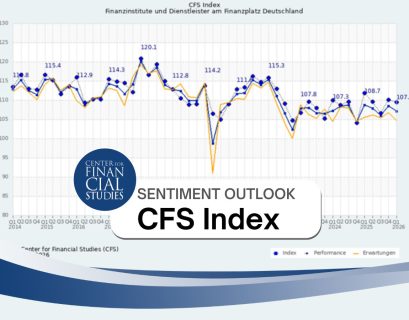
FRANKFURT, October 27, 2026. The CFS Index, which quarterly reflects the state of Germany’s financial sector, rose in the second quarter of 2026 by 6.0 points to a level of 110.3 points. Revenues grew across the industry by an average of 11.2 points. In terms of earnings growth, the service-providing companies stand out in particular with a gain of 14.1 points, while earnings at financial institutions remain permanently stable. The assessment of Germany’s importance as a financial center developed surprisingly negatively.
“The financial actors are following the encouraging overall economic development; however, it remains to be seen whether this upswing will be lasting,” comments Prof. Dr. Rainer Klump, Director of the Center for Financial Studies, on the results.

The assessment of the future international importance of Germany as a financial center declined surprisingly sharply in the second quarter of 2026. With a decline of 9.3 points, the current index value stands at 93.9 points. In doing so, the assessments of financial institutions and service-providing companies in the financial sector differ considerably: while service providers rate the future of the financial center as rather insignificant with a minus of 17.0 points, sentiment at financial institutions is rather neutral with a minus of 1.7 points and a level of 101.5 points.
“The decline in expectations regarding the international importance of Germany as a financial center primarily reflects current geopolitical and economic uncertainties as well as the altogether more restrained perception of Europe. At the same time, the solid revenue and earnings growth and the financial sector’s willingness to invest show that Frankfurt has a strong foundation. I am convinced that the financial center will again assert its strengths more clearly in a more stable environment,” explains Oliver Behrens, President of Frankfurt Main Finance.
Partly Clearly Positive Figures for Revenue and Earnings
The growth of revenues at financial institutions rose in the second quarter of 2026 by 9.9 points to 125.8 points, while service providers reported an even clearer increase of 12.4 points to a level of 109.1 points. Nevertheless, according to panelists’ assessments, financial institutions continue to perform at a higher overall level. Compared with the same quarter of the previous year, service providers show a gain of 8.1 points, similarly high to financial institutions, whose revenues grew by 8.3 points. Regarding revenue growth in the current third quarter of 2026, expectations across the entire financial sector are moderately positive.
Earnings growth developed at differing rates among the surveyed financial institutions, with a gain of 3.9 points, and the surveyed service providers, with an increase of 14.1 points. Nevertheless, the earnings situation of service-providing companies only reaches a level of 109.1 points, since the sub-index had stood at a low 95.0 points in the previous quarter. In the same quarter of the previous year, earnings growth of service providers marked the neutral reference of 100.0 points and thus rose by a respectable 9.1 points. At financial institutions, earnings growth shows a slight upward trend compared with the previous year, with a gain of 3.3.
Headcount Growth Remains Stable
In terms of headcount growth, the financial sector as a whole grew by 8.8 points. Nevertheless, this does not paint a picture of large increases in personnel acquisition. The sub-index for service-providing companies stands at 100.0 points, marking exactly the same level as in the second quarter of the previous year. Financial institutions are indeed hiring again, but here too the index rises only to a moderate 106.1 points compared with the previous year.
Little Movement in Investment Volume Growth
The growth of investment volume in product and process innovations at financial institutions rose by 4.7 points to 118.2 points. Service providers, by contrast, reported a slight decline of 0.5 points to 104.5 points. Looking back over a longer period, the sub-indices show little movement in this segment.
General Methodology of Index Calculation
The CFS Index is based on a quarterly management survey of Germany’s financial center. The index aggregates qualitative data on the company indicators “revenues or business volume,” “earnings situation,” “number of employees,” and “investments” with respect to the just-ended quarter (“performance”) and the current quarter (“forecast”). By construction, the maximum index value is 150, the minimum 50; a value of 100 signals a neutral sentiment. The survey is a panel-based survey of companies and institutions in the financial industry. Panel participants are divided into the sectors “financial institutions” and “service providers” at the financial center, whereby the second group is defined very broadly.
Brief Profile CFS
The Center for Financial Studies (CFS) conducts independent and internationally oriented research in all major topic areas of financial markets, financial institutions, and monetary economics: from financial stability and banking regulation to securities trading and valuation on financial markets, portfolio decisions of households, and law and economics of financial organizations, through to monetary policy and the economics of financial markets. The CFS contributes to political debates and analyses using relevant findings from its research areas. For its research projects and policy advice, it draws on a network of scholars and personalities from the financial industry and central banks both within and outside Europe.
Source: CFS Press release from 27 October 2026