- No “residential property bubble”: prices will rise again in 2025 after a slight decline in the previous year
- Desire for home ownership remains high: three-quarters of people in Germany want to own their own property
- Home ownership rate declines: Germany cements its role as European laggard in residential property ownership
- Housing is becoming one of the key social issues: “construction boom” must take off
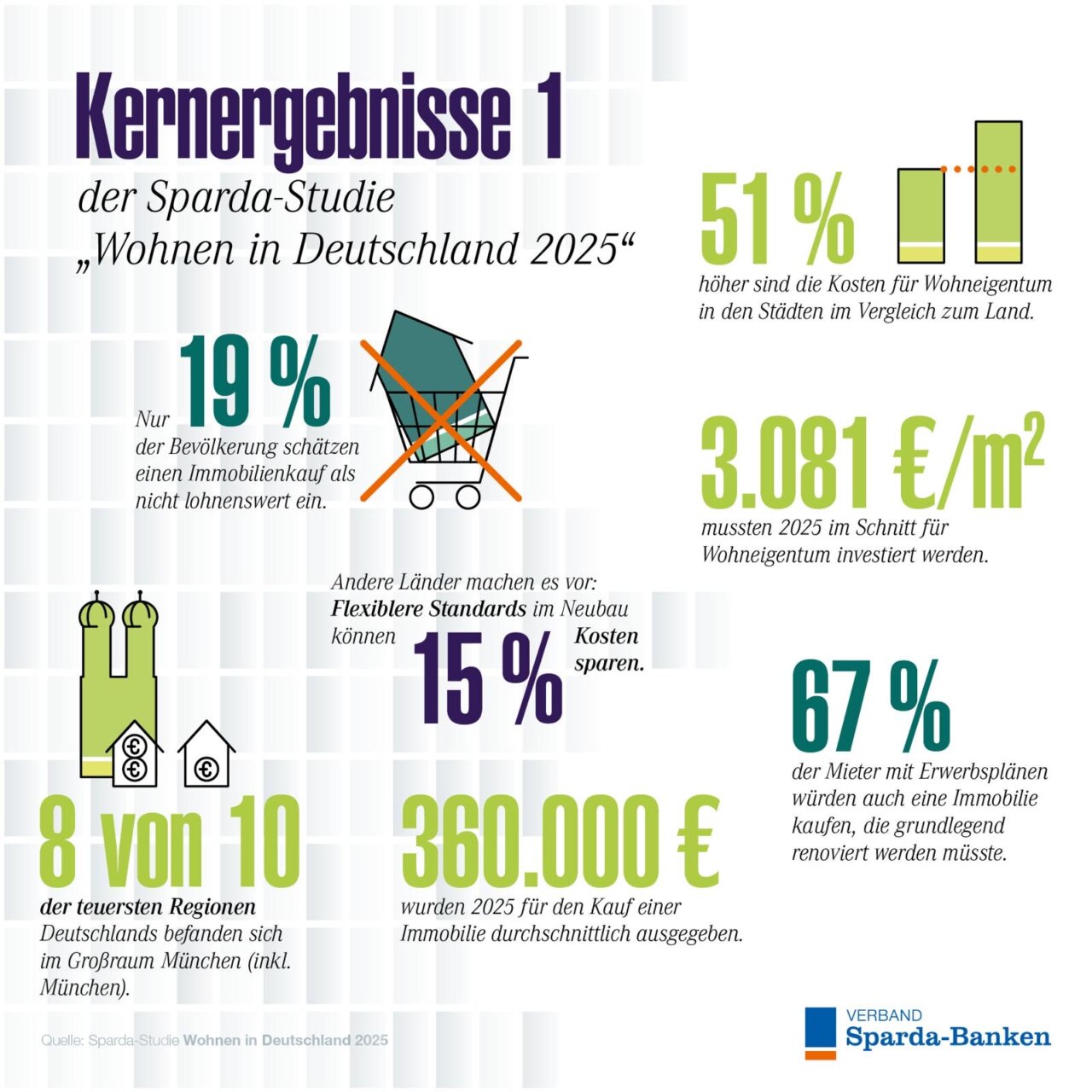
“The desire for home ownership remains strong. 74 percent of people in Germany want to own residential property. This figure has remained virtually unchanged in recent years. However, many are losing faith that they will ever be able to afford to buy their own home. The home ownership rate is falling, and Germany is further extending its last place in European comparisons. The cycle of new construction and the transition from renting to home ownership is severely disrupted, and rents are rising. When people are uncertain and can no longer afford housing, this creates considerable social tension. Housing has become one of the most pressing social issues for our country – and in our view, it is already five past midnight,” said Florian RENTSCH, Chairman of the Board of the Association of Sparda Banks, on the occasion of the publication of the 2025 edition of the Sparda study “Housing in Germany”.
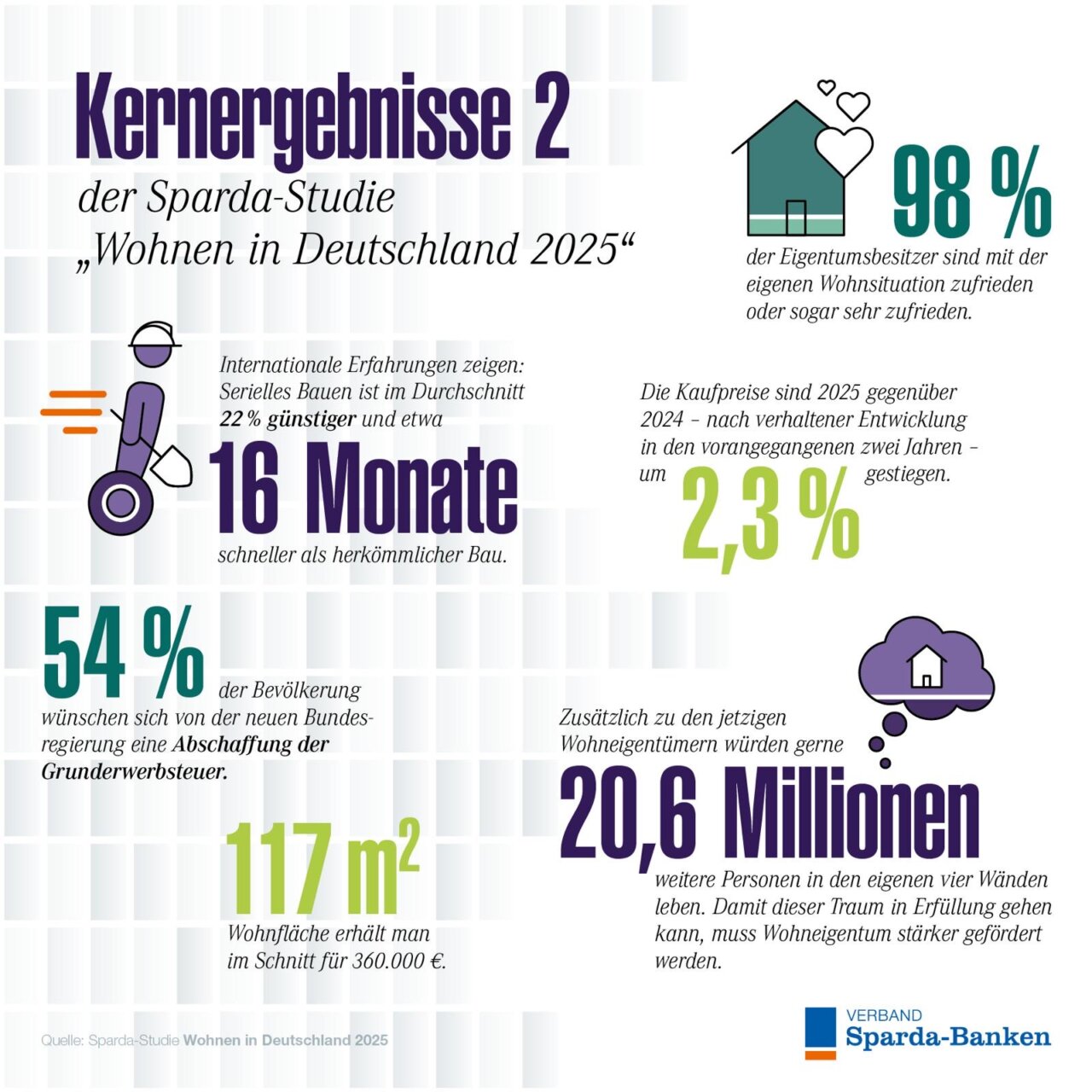
In the wake of political uncertainty, inflationary shocks and interest rate hikes, there were price corrections in 2024 – but in the first quarter of 2025, property prices rose again by an average of 2.3 percent. “Buying residential property is still worthwhile. The proverbial “concrete gold” is stable in terms of value development in the medium and long term and makes a significant contribution to retirement provision. The Cassandra calls regarding a residential property bubble have not come true. This can be explained from a market economy perspective: extremely high demand continues to meet with far too little supply. And given the far too low rates of new construction, land allocation and insufficient renovation rates in the existing stock, this is not going to change – at least in the short and medium term,” says RENTSCH.
Politicians need to take consistent measures to ensure that prospective buyers can actually afford to purchase property. Construction is still too limited, and when it does take place, it is too expensive and subject to overly complex regulations. RENTSCH continues: “The new federal government has taken a step in the right direction with its announced “construction turbo” and initial measures to facilitate residential construction projects in the Building Code. However, more courageous and innovative approaches are needed to cut through the Gordian knot of the residential property crisis. We have identified possible solutions in our study. Above all, however, sensible new regulations must not be counteracted by restrictive instruments such as rent controls. The only thing that rent controls slow down is investment in urgently needed housing.”
The capital buffer on residential property loans, which artificially increases the cost of bank loans and acts as a brake on lending, has recently been halved by the supervisory authority. “The right thing to do would have been to abolish it, because there is no discernible increase in the risk of defaults, particularly in the case of private residential property loans,” said RENTSCH.
Pekka SAGNER, economist for housing policy and real estate economics at the Cologne Institute for Economic Research, adds: “We have subjected possible measures for overcoming the residential real estate crisis to a reality check based on best practices from other countries. In doing so, we have identified numerous instruments that would also be worthwhile in Germany and could be implemented relatively quickly. For example, more flexible standards and simplified technical regulations have reduced construction costs by between 12 and 15 percent in France, Sweden and the Netherlands. Similarly, pre-approved type approvals, as in Australia, and digitisation of the building application process, as in Finland, have led to considerable savings in time, bureaucracy and costs in residential construction.”
“We remain convinced that, despite all the fluctuations in the interest rate market and global uncertainties, buying residential property is worthwhile in the medium and long term. Politicians now need to follow up their announcements with action and quickly improve the framework conditions for home buyers,” said RENTSCH.
About the “Living in Germany” study
For the seventh time, the Association of Sparda Banks (Verband der Sparda-Banken e.V.) has published its “Living in Germany” study, one of the largest representative studies in Germany. In cooperation with the Cologne Institute for Economic Research (IW), IW Consult GmbH and the Allensbach Institute for Public Opinion Research (IfD), a comprehensive analysis of regional price developments in the residential property market, the affordability of real estate and commuter movements has been carried out since 2017. The study also takes into account the effects of macroeconomic and political developments and examines the future viability of regions in Germany.
These and many other exciting findings, as well as an interactive tool on price developments and future opportunities in your region, can be found in the new Sparda Housing Study 2025 at Wohnen in Deutschland 2025 – Sparda Wohnen in Deutschland 2025 (german).
About the Association of Sparda Banks
The Association of Sparda Banks e.V., based in Frankfurt am Main, is an auditing association within the meaning of the German Cooperative Act. As a “staff unit”, it also acts as the group’s mouthpiece to the outside world. In addition to auditing its members, the association is also responsible for advising and supporting the legally and economically independent Sparda banks in cooperative, legal, tax, business, organisational and personnel matters. Furthermore, it represents their interests and promotes political debate on social and financial issues.
About the Sparda Group
The Sparda Bank Group consists of eleven economically and legally independent Sparda banks in Germany. With 3.7 million customers and over 3 million members, the institutions are among the most important retail banks in Germany. The Sparda banks are cooperative members of the National Association of German Cooperative Banks (BVR) and part of the Cooperative Financial Network.