
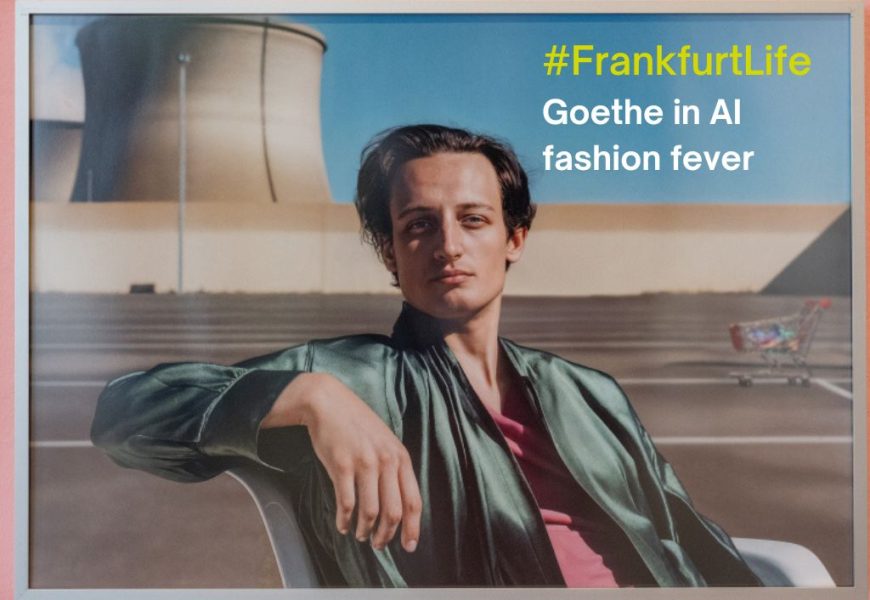
A special exhibition at the museum on the topic of “New Realities – Fashion Fakes and AI Factories” explores the links between the fashion and AI industries. It focuses on communication, artificial intelligence, and digital image aesthetics with an emphasis on fashion. At first glance, fashion may seem an unusual topic for artificial intelligence, but it provides visitors with easy access to the potential and limitations of AI.


Dr. Annabelle Hornung, the museum’s new director since January 1, 2025, who curated the exhibition together with Maren Burghard and Stephanie Müller, emphasizes, “People wear fashion, machines make fashion, and the museum displays fashion. But it’s not as easy as it seems.” With its various narrative strands, the exhibition aims to encourage visitors to “get to grips with” AI. Most of the exhibition’s content—not just the photos—was developed with the help of specialized AI assistants.
Glamorous photos of fashion and the working world
The focus is on fashion photos that showcase not only the clothing but also the surroundings: you see seemingly everyday scenes—people in parking lots, in front of cooling towers, or waiting. At first glance, these are realistic motifs based on classic fashion photography and youthful beauty standards.


Language has proven to be a bottleneck in image design. The language used in the text prompts determined how AI depicts people, including their environment and possible stereotypes. “AI does not reinvent the world. It creates something new by combining the knowledge it has acquired during training from more than 5.85 billion image-text pairs and interpreting the text inputs of users,” explains a piece of information.
The curators also “commissioned” the AI to give the uniforms of postal workers from the 19th and 20th centuries in the Museum of Communication’s collection a “facelift” for the year 2025. Based on an analysis of stylistic and functional features, the AI developed visual designs. However, the AI was unable to take all the necessary criteria into account to design a garment that was immediately functional—whether it was incorrect draping, incorrectly placed cuffs, or the use of unsuitable materials.

AI also presents the world of work in a far too idealistic light: another photo series shows everyday working life – with lots of green plants, spacious workstations in almost deserted offices, and machines in clean, tidy factory halls. The AI failed when asked to take a photo of an old rotary dial telephone. There is probably too little information about this “classic” on the internet, so the AI confused the dial and the receiver.


AI as an important tool and creative addition
In an interview for AI Magazine about the exhibition, fashion designer Samuel Gärtner and co-CEO of Strauss Clothing, Henning Strauss, agree that AI is already influencing the fashion industry in many ways. AI can serve as a source of inspiration and digital sparring partner in the design process, or facilitate technical processes that reduce labor and material waste. For smaller labels, it is becoming possible to implement impressive campaigns on a smaller budget. “The decisive factor remains the user, who employs AI in a targeted and creative manner – and thinks innovatively about the results,” says Henning Strauss.
A talking sewing machine
Among numerous other exhibits is a talking sewing machine that recounts its fictional history as Karl Lagerfeld’s assistant. An AI-generated voice combines real statements from 50 pages of original interviews with the fashion designer. The sewing machine shows how effortlessly AI can shape narratives and rewrite history.

In the room installation “Input, Output,” AI has left the digital world. The curators only gave AI a loose framework. From this, AI developed the office of a fictional fashion union with a desk, air conditioning, a reading corner, a laundry basket, and, of course, photos, notes, stickers, and posters on the walls. At a media station, visitors can also test how accurately they can recognize AI-generated images.


Information
The exhibition is on display until January 11, 2026, at the Museum for Communication Frankfurt, Schaumainkai 53, Frankfurt. Opening hours are Tuesday to Sunday (and on public holidays) from 10 a.m. to 6 p.m., and Wednesdays until 8 p.m. A specially curated AI Fashion Magazine has been published to accompany the exhibition, featuring creative and critical content including expert interviews from the worlds of science, fashion, and industry, as well as glamorous AI-generated fashion photos and advertisements for fictional luxury brands.
Further information is available at https://www.mfk-frankfurt.de
Text and photos: Dr. Wolfgang Gerhardt.