
With its erratic, difficult-to-interpret, and hardly predictable decisions, the new US administration has contributed to uncertainty in the financial markets. While markets have reacted with surprising calm after initial turbulence, the debate over the future role of the US dollar and the global dominance of the American bond market continues.
“The new US President does not seem to realize how much the country benefits from its unique geo-economic position of ‘exceptionalism’—a status that brings both power and responsibility,” explains Ingo R. Mainert, Deputy Chairman of the DVFA, and adds: “The responses to our latest monthly question show that the era of the US dollar as a safe haven and global reserve currency is being questioned. However, most do not foresee a radical shift at the top of the global financial system.”
America’s role in the international financial system is only moderately declining
13% of survey participants expect the US to maintain its current level of importance in the global financial system. In contrast, more than two-thirds (68%)—the clear majority—expect a moderate decline. Nearly one in six (15%) anticipate a significant loss of influence, while only 4% remain undecided.
US Treasuries no longer seen as a “safe haven” by many
In mid-May, Moody’s downgraded the United States’ credit rating from Aaa to Aa1. In light of this downgrade, as well as geopolitical shifts and domestic political developments, 60% of DVFA Investment Professionals now consider the status of US Treasuries as a “safe asset” to be at risk. Only about half as many (29%) disagree, while 11% are currently unable to offer a clear opinion.
US benefits from a clear yield advantage due to its dominance
One of the key economic advantages the US enjoys thanks to the strong position of the dollar and US markets is a clear yield advantage over what would be a “fair” interest rate—the so-called “convenience yield.” However, only around half of the responding Investment Professionals were able to estimate this discount in long-term US Treasuries:

Estimated US yield advantage
4%: less than 25 basis points
30%: between 25 and 50 basis points
18%: more than 50 basis points
Source: DVFA e. V
The remaining 48% of participants chose alternative response options.

🟧 ”This yield advantage does not exist in my view” — 13%
🟦 ”This yield advantage likely exists, but is difficult to quantify” — 35%
US dollar is losing ground as the world’s reserve currency
DVFA Investment Professionals largely agree: the significance of the US dollar as a global reserve currency is trending downward—either significantly (21%) or slightly (67%). Only 7% believe there will be no decline.
Majority sees US dollar as overvalued
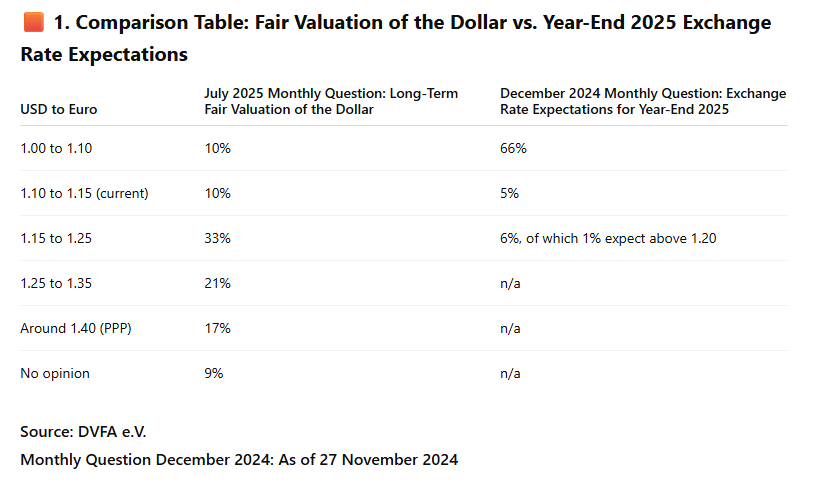
Participants were also asked how the US dollar should be assessed in terms of its long-term fair value, for example using purchasing power parity as a benchmark. Only 10% of respondents currently consider the US dollar to be undervalued. Another 10% believe the current exchange rate level is fair. However, the majority (71%) view the dollar as overvalued in the long term—some even significantly so. Just 9% refrained from giving an opinion.
The question of fair valuation is conceptually different from that of the expected exchange rate at the end of 2025. Nevertheless, the following table—based on results from the December 2024 Monthly Question—shows how “Trumponomics” has since shaped perceptions of the US dollar.
Comparison of the Dollar’s Fair Valuation and the Exchange Rate Expectations at the End of 2024
MSCI World not seen as an adequate equity benchmark
When asked whether the MSCI World—with more than two-thirds of its weight in US equities—still serves as a suitable benchmark for strategic asset allocation, the response was clear: 68% answered “no,” while only 28% said “yes.”
Many question the Fed’s actual independence
The DVFA also asked whether the US Federal Reserve would remain independent during Donald Trump’s presidency. Here, half of the respondents expressed skepticism: 8% gave a clear “no,” and another 42% do not expect formal legislative changes, but assume that the Fed will effectively come under political influence.
More than one-third of Investment Professionals (34%) were more optimistic and believe the Fed’s independence will not be at risk. The unpredictability of US developments is also reflected in the fact that 16%—nearly one in six—did not want to commit to a position.
“In summary, our Investment Professionals expect a weakening of the United States’ role in the global financial system, but not a loss of its leadership position,” concludes Ingo Mainert.
Given around USD 36 trillion in national debt, the threat of rising interest rates—and thus increasing fiscal pressure on the US budget—could become a serious concern. In the end, it may be the financial dominance of the capital markets that compels Donald Trump to act with greater economic rationality and predictability—and to respect the independence of the central bank.
Source: DVFA Monthly Question – July
Translated with DeepL