
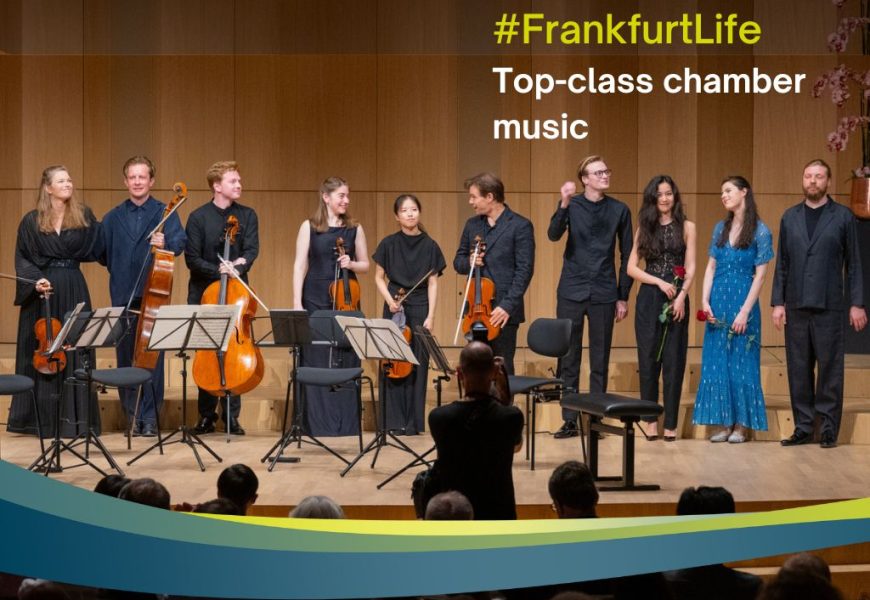
On October 20, 1993, the 20th anniversary of the death of cellist Pablo Casals, the success story of the Kronberg Academy began. His widow, Marta Casals Istomin, opened the first music festival in Kronberg on that day. The world-famous cellist Mstislav Rostropovich also took on the role of patron. The foundation was initiated by cellist Raimund Trenkler, who has been the artistic director of the Kronberg Academy ever since, together with private sponsors.


The Kronberg Academy is committed to Pablo Casals’ maxim on art and humanity: “First and foremost, I am a human being, secondly an artist. As a human being, it is my duty to do good for my fellow human beings,” as the artist put it. The goal is therefore “to keep classical music strong and alive at the highest level as an art form and a common language for all people in the future.”
Training and inspiration for highly talented young chamber musicians
The Kronberg Academy brings together highly talented young violinists, violists, cellists, and pianists, pairing them with established artists to create an environment for training, interaction, and inspiration. Currently, more than 40 musicians from over 20 countries are studying in Kronberg. The aim is to help these talented individuals develop into responsible artists who will go on to shape classical music worldwide, for example as soloists or in leading positions in major orchestras. The course is designed to provide the “finishing touches” for their future careers.
The multi-year courses are tailored to the individual needs of each student in terms of content and duration. A partnership with the Frankfurt University of Music and Performing Arts enables students to obtain a bachelor’s and master’s degree. Young pianists are involved in the Sir András Schiff Performance Program for Young Pianists, which focuses on chamber music.
Public performances and concerts, including master classes and rehearsals, are naturally a central element of the training. They offer students the opportunity to perform in front of an audience. For many years, these concerts took place in town halls, churches, and other venues in the region—often with less than satisfactory acoustics.


Casals Forum with sophisticated acoustics
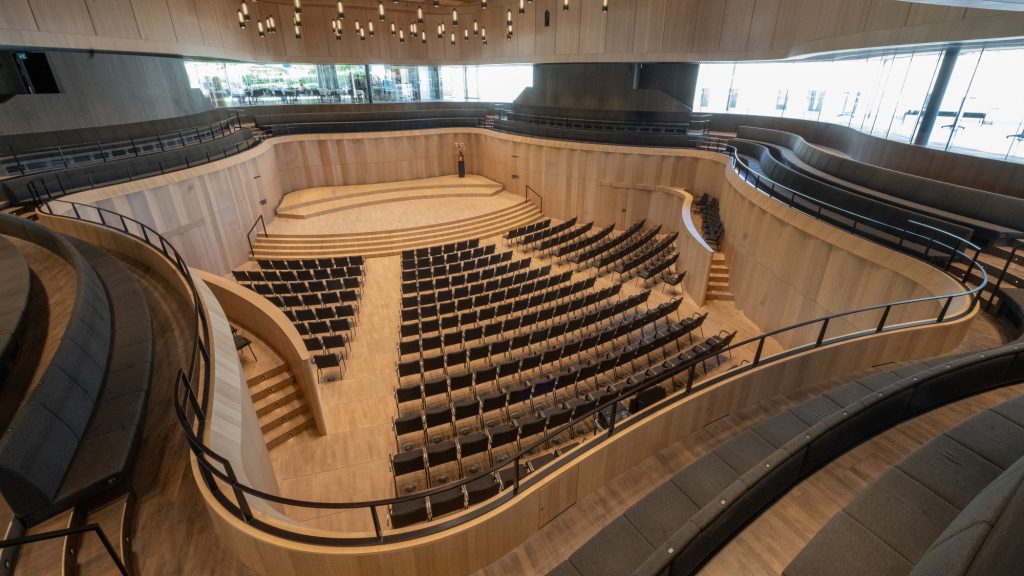
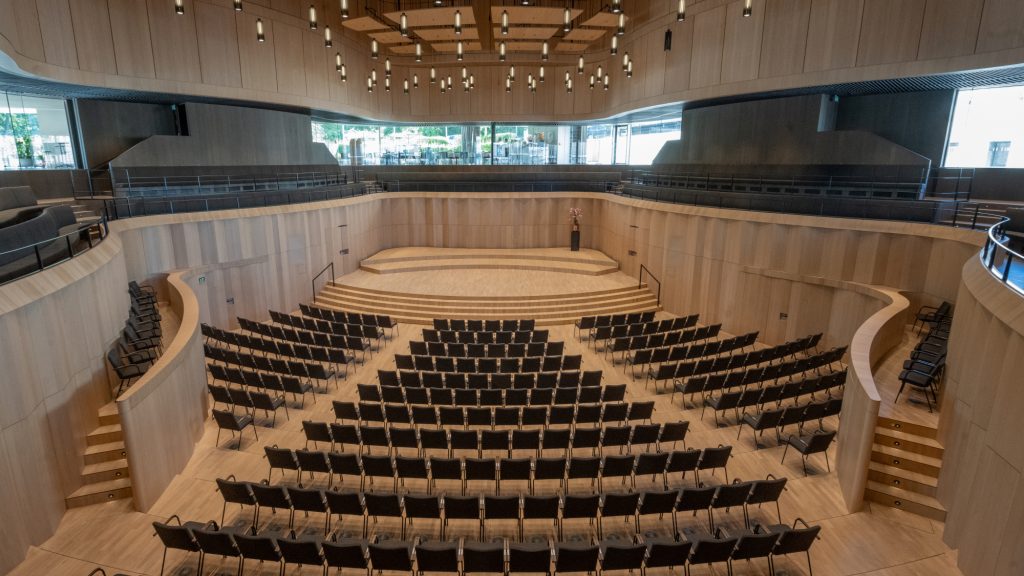
Since September 2022, the Kronberg Academy has had its own concert hall. On the site of the former coal storage yard for Kronberg railway station, the Berlin-based architectural firm Staab designed a multi-award-winning building complex comprising a concert hall, a smaller Carl Bechstein Hall, rehearsal, study, and administrative rooms, and an adjoining hotel. The silhouette of the pavilion-like, transparent Casals Forum corresponds to the town’s landmark, Kronberg Castle. Thanks to an innovative ice storage system, it is the first concert hall in Europe to be operated in a CO2-neutral manner.
At first glance, the large concert hall of the Casals Forum, with its 550 seats, is somewhat reminiscent of the body of a violin or cello. The volume of the room, the curved convex and concave walls, the continuous balcony area around the stage and stalls, and the selected woods and other materials enable sophisticated acoustics that are specially designed for chamber music and create a comparable sound experience in all seats. Thanks to these acoustics, designed by Dutch architect Martijn Vercammen, numerous experts rate the Casals Forum as one of the best chamber music halls in the world.


A wide-ranging concert program
The new building has enabled the Kronberg Academy to almost triple its diverse program of events. More than 160 public concerts are planned for the 2025/2026 season. This year’s Kronberg Festival will be opened by the Chamber Orchestra of Europe and pianist Sir András Schiff. A jazz series with Fred Hersch will start in October, and the “Concerti Brillanti” will continue in November. The “Chamber Music Connects the World” festival will follow in May 2026.


Almost every week, there are “Wednesday concerts” that are planned and organized by the students themselves. The exam concerts under the motto “Masters in Performance” and master classes are open to the public. At “Bach im Fluss” (Bach in the River), works by Johann Sebastian Bach for solo instruments such as harpsichord, oboe, or even accordion are presented. Since 2024, renowned artists have been collaborating with colleagues and the Kronberg Young Soloists to organize three concerts over a single weekend as “friendship concerts.” In June of this year, violinist Janine Jansen, who will be artist in residence with the Berlin Philharmonic in the coming season, was a guest in Kronberg.


Broad private, civic engagement
The federal government contributed nearly €22 million and other public bodies contributed nearly €6 million to the pure construction costs for the Casals Forum, which amounted to more than €60 million, as a “lighthouse project for Germany.” However, the remaining financial requirements and, above all, the total running costs are mainly financed privately – by companies and foundations as well as by private individuals who, for example, take on sponsorships, patronage for orchestra projects and study places, or even chair sponsorships. The Friends of Kronberg Academy e.V., which now has over 2,300 members, play an important role in promoting and integrating the academy into the region.

Plans for extension
The Kronberg Academy is already making plans for the future: the Kronberg Academy campus is to be completed with the construction of a student residence where students will find a shared home and ideal conditions for their personal practice. This building will also house an Institute for Music and Health, where the positive effects of music on people will be researched from a medical and scientific perspective.
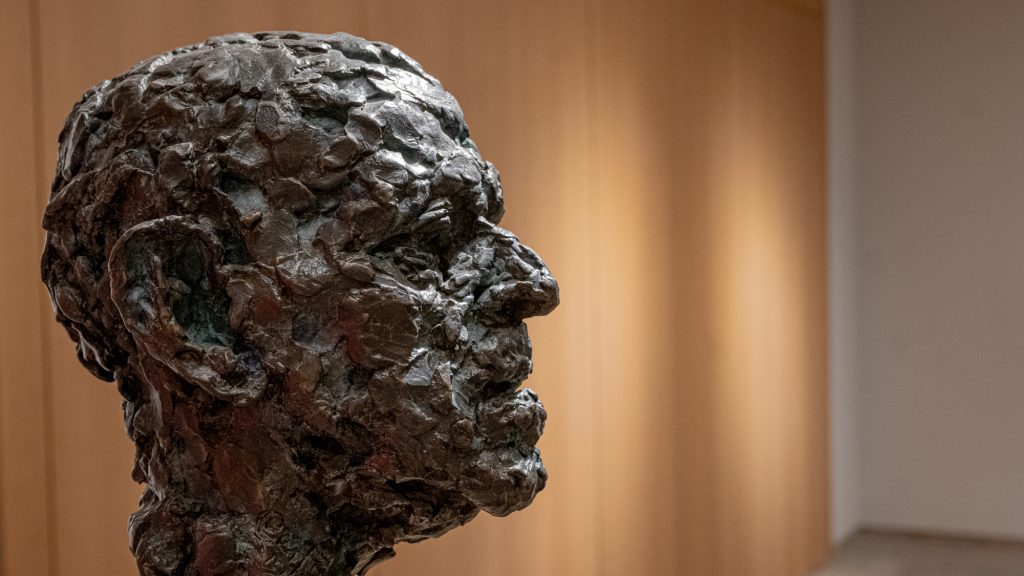
Incidentally, the Casals couple are not only present on campus in name: on the ground floor there is a bronze bust of Pablo Casals, commissioned by the United Nations in 1971. Upstairs, “Marta’s Cafe” is named after his widow. There, friends of the Kronberg Academy can chat over freshly baked cakes and aromatic coffee.


Information
The Kronberg Academy campus, located at Beethovenplatz 1 in Kronberg im Taunus, is directly adjacent to the terminus of S-Bahn line 4, 22 minutes from Frankfurt Central Station. Detailed information, event listings, and tickets are available at www.kronberg-academy.de. Public tours of the Casals Forum, the Carl Bechstein Hall, and the rehearsal rooms are offered regularly.
Text and photos: Dr. Wolfgang Gerhardt.