Background:
On 30 October, the European Central Bank announced that preparations for the introduction of a digital euro are entering the next phase. In fact, the preparations are already so advanced that the corresponding EU regulation (a draft has been available since 2023) is expected to be finalized as early as 2026. This requires only the approval of the European Council and the European Parliament; national parliaments do not need to be consulted. Meanwhile, critical voices from the financial industry and parts of the political sphere are becoming increasingly vocal.
Survey results:
More than 60% (62.3%) of the surveyed professionals and executives from the financial sector do not consider a digital euro necessary, given the wide range of existing payment instruments. By contrast, just under 33% do see a need for it.
A similar picture emerges when looking at the expected acceptance of a digital euro among private customers. Here too, around 67% of respondents anticipate low or very low acceptance, citing the abundance of well-established digital payment instruments.
“The survey shows that the financial industry is skeptical of the digital euro in its currently envisaged form. Most respondents expect low acceptance among customers,” says Professor Volker Brühl, Managing Director of the Center for Financial Studies.
With regard to the sensitive issue of data protection (privacy), opinions among the panelists are fairly balanced. Just under half (49.6%) consider the risk of insufficient data protection to be high or very high, while 45.1% assess this risk as low or very low. The picture is more clear-cut when it comes to the assessment of the risk of hacker attacks on holdings of digital cash: almost 70% rate this risk as high or very high.
“Cybersecurity is a particularly critical issue when it comes to digital central bank money. Even though 100% security will never be achievable, the ECB must provide better answers here than it has so far,” Brühl continues.
The impact of a digital euro on the profitability of the banking sector is being discussed controversially. On the one hand, banks are to be compensated for certain services. On the other hand, basic services (e.g. deposits and withdrawals) are intended to be free of charge. In addition, there are costs arising from integration into the existing IT landscape and potentially lost revenues in payment services.
Against this background, more than 65% of the panelists assess the impact on the banking sector as negative or very negative.
“The market for digital assets is growing rapidly. Technology, market infrastructure, and regulation are established, and use cases already exist and have been tested. 2026 is likely to be the year of the breakthrough. The extent to which the digital euro will play a decisive role will largely depend on whether the ECB shifts its focus from retail to wholesale use. A decision by the ECB Governing Council on issuing the digital euro is expected in the second quarter of 2026. The costs are estimated at between €6 and €18 billion. It will be important to focus on the economic benefits behind these costs,” says Hubertus Väth, Managing Director of Frankfurt Main Finance.
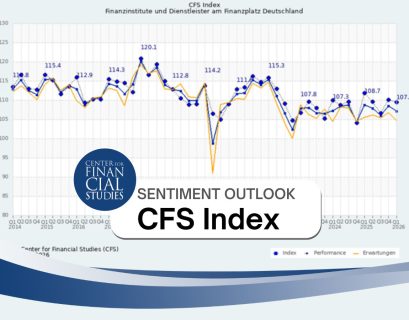
CFS Index in the 3rd Quarter of 2025
Source: CFS press release dated December 18, 2025