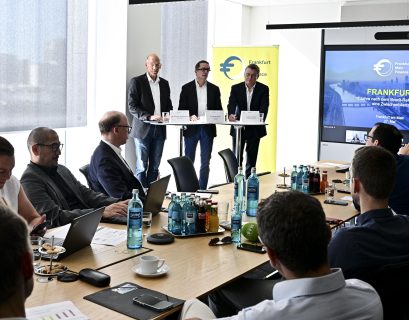
Mr Väth, how important is Frankfurt am Main as a financial centre?
Frankfurt am Main is the most important financial centre in Germany and the European Union. According to the latest Global Financial Centre Index survey from the end of September, Frankfurt ranks 12th among the world’s most important financial centres. The financial sector, i.e. banks, stock exchanges and insurance companies, employs around 85,000 people in the region. This concentration not only strengthens the Rhine-Main area as a business location, but also makes the region a driver of innovation, employment and international prestige.
Can you briefly explain what the Frankfurt Main Finance e.V. financial centre initiative is?
Frankfurt Main Finance is the financial centre initiative of the cities of Frankfurt, Eschborn and Offenbach, as well as the state of Hesse. It brings together around 80 members – including the stock exchange, national and international banks, asset managers, auditors, consultancies, media companies and start-ups – with the aim of strengthening Frankfurt as a financial centre both nationally and internationally. The initiative promotes the attractiveness of the location worldwide, connects stakeholders and supports dialogue between business, politics and society. It focuses in particular on topics such as sustainable finance, digitalisation and Frankfurt’s international positioning.
Who are the most important players and members in your network?
We have many big names among our members, with international appeal. That is something that gets noticed. But for us, whether it’s cities or countries, stock exchanges or financial institutions, service providers, media companies, professional organisations or universities, every member contributes in their own way and according to their means to fulfilling our mission. In addition, we often receive significant support from well-known non-members, especially those who, for whatever reason, are unable to join.
How can one imagine the cooperation between the approximately 80 members of Frankfurt Main Finance?
That always depends on the task at hand. For analyses, we rely on consulting firms. For specific advertising, we rely on the city and state. The establishment of the ISSB required different players than those involved in the AMLA. Bringing SIBOS to Frankfurt and using it as an advertising platform required different partners than those involved in the appearances in Davos, at the COP or at the IMF/World Bank meeting in Washington. Cooperation is situation-specific. However, we make sure to constantly offer all members platforms and forums where they can present themselves or network.
We have also strengthened our role in the Financial Centre Cabinet, which was established by Hesse’s Minister President Boris Rhein and, in short, has set itself the task of consolidating and expanding Frankfurt’s leading position as a financial centre. To this end, the Financial Centre Cabinet has adopted a strategy and drawn up a charter of cooperation. In future, there will be greater cross-disciplinary work in the six areas of location conditions, risk & regulation, innovation & start-ups, sustainable finance, science & education, and marketing & communication, as soon as the additional funds for this are available.
Frankfurt Main Finance also has a total of 15 international financial centres as cooperation partners. What are the advantages of this?
Germany is an export nation. Financial services follow trade. Just as German products are successful all over the world, the financial centre is also a sought-after role model. The international network of Frankfurt Main Finance opens up access. This enables us to identify opportunities, share best practices and position the Frankfurt financial centre visibly in global competition. For our members, this results in direct contacts with international partners and new business opportunities. At the same time, this networking strengthens Frankfurt’s role as a bridge to the world’s emerging, young markets.
Do you consider the international networking of Frankfurt am Main as a
financial centre to be a particular advantage for skilled workers from abroad
to live and work here?
Yes. Frankfurt is a city that you fall in love with at second glance. It is important to give many people the opportunity to see and experience this city. The numerous visitors to SIBOS in particular showed us how much they had underestimated Frankfurt. We need to present ourselves as an attractive destination for sought-after professionals from all over the world. Here, they will not only find exciting career opportunities with global companies, but also an environment characterised by openness and diversity.
„Frankfurt is a city that you fall in love with at second glance."
Hubertus Väth
What is the relationship with other financial centres such as London, Paris, Luxembourg and Geneva like?
Frankfurt has a dynamic relationship of cooperation and competition with these financial centres. Of course, there is healthy competitive pressure, for example when it comes to attracting financial institutions or market share. At the same time, however, these financial centres are closely networked and work together on issues such as regulation, sustainability and the promotion of innovation. For Frankfurt, this means that exchanges with other locations give the financial centre additional strength and international relevance.
What role does the internationally active Messe Frankfurt play in this?
Its long tradition as a trade fair city at a major hub of important trade routes has contributed significantly to Frankfurt’s development into an international trade and financial centre. Merchants, investors and ideas from all over the world came together here early on – laying the foundation for its current role as a global financial centre. Sibos, one of the world’s most important financial trade fairs for payment transactions, technology, security and trade, was recently held in Frankfurt. This not only creates network effects, but also increases the global visibility and attractiveness of the location.
Where do you see the greatest opportunities and risks for Frankfurt am Main as a financial centre in the coming years?
The greatest opportunities for Frankfurt as a financial centre lie in its role as a leading centre for sustainable finance, digitalisation and innovative technologies such as big data analysis and the development and application of artificial intelligence for the financial industry. At the same time, there are risks. In addition to current geopolitical uncertainties, which we cannot change and must deal with, we in Germany tend to complicate EU regulatory requirements even further. This not only ties up resources and incurs costs, but also hinders us in international competition between locations.
Source: Newcomers Guide 2026