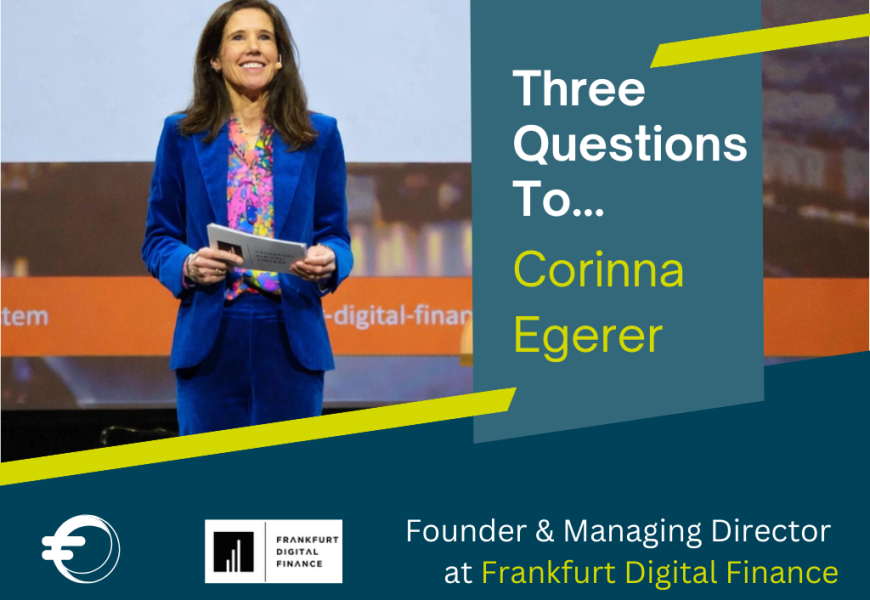
The Frankfurt Digital Finance Conference will enter its seventh edition in 2026. Since 2020, the framework conditions for the financial sector have changed significantly—from geopolitical challenges and the imperative of digital transformation to questions of financing growth, security, and technology. How is this evolution reflected in this year’s conference program, and what new emphases are you setting?
We have reached a point where the question is no longer whether digital transformation will happen, but how it can be operationally implemented under intense global competitive pressure. It is not sufficient for Europe to excel at invention if value creation ultimately takes place elsewhere. We often observe strong early-stage financing, yet lose momentum during the decisive growth phase. Under the motto “Europe, Seize the Moment,” we therefore place growth financing firmly at the center. Even the most promising innovations are of limited value if they cannot be scaled within Europe.
This is precisely where we intervene. We discuss how mobilising private and public capital can deepen European capital markets to such an extent that scale-ups choose the path to IPOs within Europe. A key lever to overcome European fragmentation is the “EU Inc” initiative and the “28th Regime.” The concept of a supranational legal form is not a bureaucratic technicality; it is a strategic milestone. It would enable startups to scale cross-border under a single regulatory framework rather than failing at 27 national barriers. This would significantly reduce administrative complexity and make Europe truly visible as an integrated investment space. Frankfurt, as an international hub, is the ideal place to shape this economic strength—because it forms the foundation of our sovereignty.
The temporal proximity to the Munich Security Conference and the debates on digital and monetary sovereignty highlight how closely financial and security policy are now intertwined. What responsibility does Europe bear in this field of tension, and how does the presence of international stakeholders strengthen Frankfurt as a financial center?
Europe’s responsibility lies in safeguarding technological and monetary sovereignty—and today, this is determined by infrastructure. We examine this tension very closely. On the one hand, we rely on the innovative capacity of global hyperscalers. On the other, Europe must preserve its own independent cyber intelligence in cloud infrastructure and cyber resilience. This is not about protectionism, but about optionality and resilience in critical scenarios.
The same applies to payments. We are moving from theoretical debates to practical implementation. How can e-money, stablecoins, or deposit tokens be used concretely for programmable payment flows and real-time settlement? The efficiency gains for Industry 4.0 are substantial. At the same time, we take the global context into account. While Europe has created regulatory clarity with MiCAR, it must compete with initiatives such as the U.S. Genius Act. Frankfurt is the natural nexus in this respect. When global technology firms and banks convene here, it is because they know that decisions on the strategic use of these infrastructures for the European market are shaped in Frankfurt, in close proximity to the ECB.
With topics such as artificial intelligence, digital assets, tokenisation, and the European Fintech Day, the conference clearly focuses on Europe’s innovative capacity. How do you intend to foster collaboration between established financial institutions, start- and scale-ups, and technology companies so that Europe not only keeps pace globally but assumes a leading role?
We must move beyond pure technology hype toward robust business cases. In Europe, innovation rarely fails due to a lack of ideas; it fails at execution, scaling, or integration into the legacy systems of the traditional financial industry. Our objective is to demonstrate how technologies such as artificial intelligence, quantum computing, or tokenisation can be transferred directly from the lab to the balance sheet. We need to show that these technologies can reduce costs or unlock entirely new revenue streams.
A functioning venture capital market is also a critical driver of growth. With the European Fintech Day, we create a space where these ecosystems converge productively. We bring the technological dynamism of startups together with institutional investors, regulatory expertise, and the balance-sheet strength of established banks. Frankfurt Digital Finance acts as the catalyst that transforms loose connections into genuine partnerships. Only by pooling these forces and integrating complementary strengths can Europe maintain its position in global competition and act as a strong pole within the international network.
Frankfurt as a Financial Center Must Be Capable of Hosting a Leading International Conference!
About the Event:

The seventh edition of Frankfurt Digital Finance will take place on 11–12 February 2026 at the Gesellschaftshaus Palmengarten in Frankfurt am Main. The two-day conference focuses on the future viability of the European financial market. Since its inception in 2020, Frankfurt Digital Finance has established itself as one of Europe’s most significant platforms for the future-oriented themes of the financial industry. The conference bridges tradition and innovation, bringing together stakeholders from across the ecosystem—from startups and established banks to investors. Its objective is to actively support the digital transformation of the sector while developing a sustainable vision for the future of the European financial industry. Through inspiring keynotes, practice-oriented workshops, and extensive networking opportunities, the event promotes exchange across industries and national borders.
Frankfurt Digital Finance on social media: #FDF2026
LinkedIn: Frankfurt Digital Finance
Instagram: @fdfconference
X: @fdfconference
YouTube: Frankfurt Digital Finance