
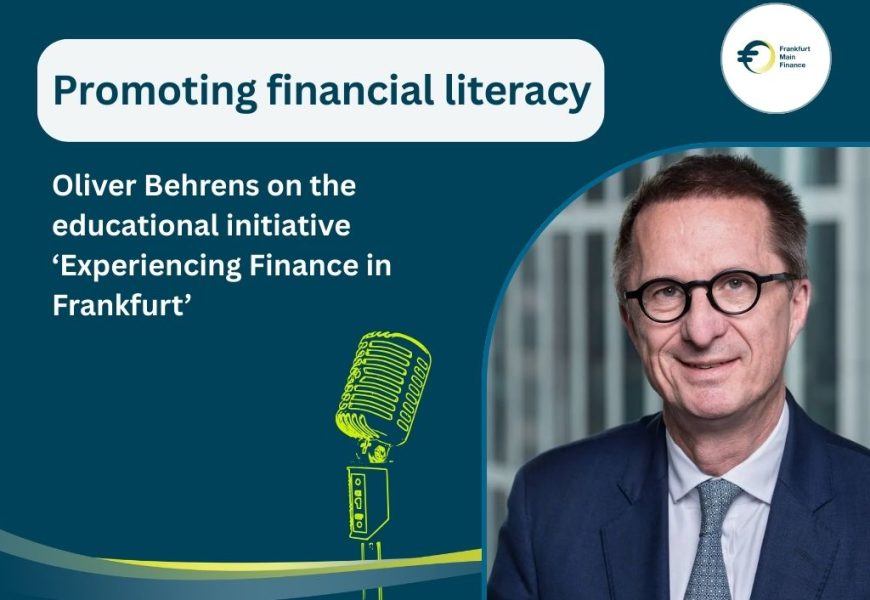
Since March 16, Frankfurt Main Finance has been offering the lecture program ‘Experiencing Finance in Frankfurt’ on its website. What are the reasons behind this financial education initiative?
In 2024, the OECD examined the financial literacy of populations in 38 countries and described the financial competence of adults in Germany as generally solid, but with clear deficits in more complex topics such as long-term retirement planning, inflation-adjusted thinking, diversification, and the digital financial world. A youth study by the German Banking Association from the same year speaks of “financial education with deficits” and highlights that while many young people have a bank account, they only have a superficial understanding of key investment or debt concepts. If the resulting shortcomings—such as limited long-term planning, insufficient protection against shocks, and a limited understanding of risk-return relationships—are to be addressed, efforts must focus on improving financial education among the population. Actors at the financial centre have long offered a wide range of educational programs. To bring these more into focus and make them easier to access, the initiative “FeiF – Experiencing Finance in Frankfurt” was launched.
Is the visit program aimed only at young people?
Not exclusively, but primarily. With the debate around the Frühstart-Rente as a new, government-supported retirement model for children and young people in Germany, the financial situation of the younger generation has once again moved into focus. A recent study by the BVR has shown that young people recognize the importance of financial planning, but are not always able to fully achieve their savings goals. Among 14- to 19-year-olds, the necessary level of savings exceeds the actual amount saved by a factor of three, while among 20- to 29-year-olds it is roughly double.
Closing these gaps requires a substantial amount of financial know-how. Young people can benefit from this in many ways. Those who start early naturally need significantly smaller monthly contributions to reach the same final wealth than someone who begins 10–20 years later. A long investment horizon also allows for a greater share of equities or ETFs in a portfolio, as short-term fluctuations can more easily be weathered over many years.
In general, the principle is clear: those who acquire financial know-how early, plan budgets, and invest develop financial habits and competencies that last a lifetime.
What further plans does Frankfurt Main Finance have regarding financial education?
First of all, I am very confident that the range of visits and lectures offered as part of FeiF will continue to grow. There are also plans to expand the program by adding digital formats such as webinars.
In addition to improving financial education among the broader population, we will also seek to promote the intellectual infrastructure of the financial center in a more targeted way. With institutions such as the ECB, the Bundesbank, EIOPA, ISSB, the House of Finance, and the Frankfurt School of Finance & Management, we have an exceptional ecosystem in the financial sector.
As a financial center, our goal should be to become a leader in forward-looking areas such as digital finance, sustainable finance, artificial intelligence, and regulation. To achieve this, for example, research collaborations between universities and financial center stakeholders can be specifically supported.


