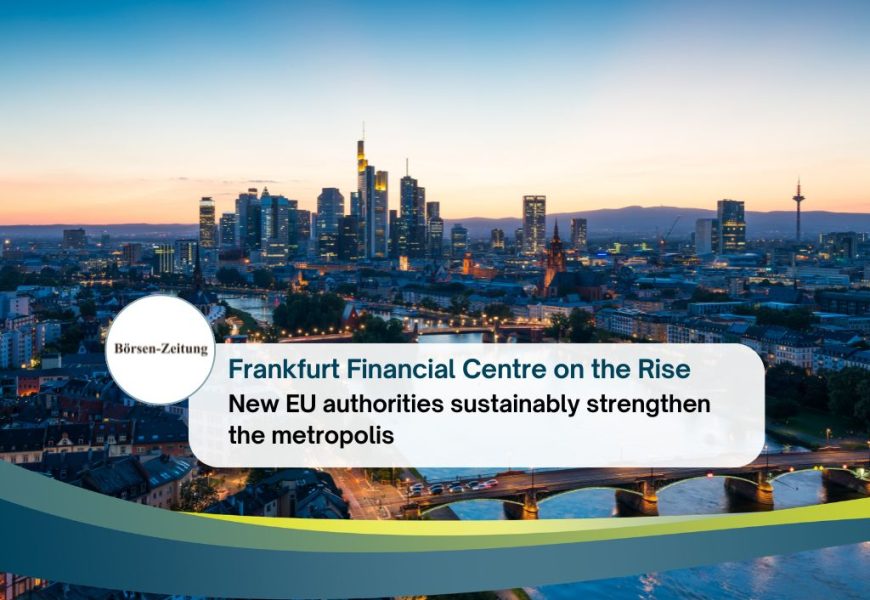
A great deal continues to be in motion in the Main metropolis, and this year the local location is shaped by the themes of design and the financial centre. Frankfurt and the Rhine–Main region have been selected to hold the title World Design Capital in 2026, thereby serving as an international stage for design.
On the occasion of the 20th anniversary of Helaba’s Financial Centre Research, our new study will be published later this year. Building on our foundational study from 2006, we have examined a wide range of changing key topics over the years and have thus continuously supported the further development of the Frankfurt financial centre.
Capital of financial supervision.
Moreover, Germany’s financial centre is becoming increasingly important in its role as the capital of European financial supervision, which also strengthens its international visibility and positioning. At the beginning of the year, the EU authority for combating money laundering, the Anti-Money Laundering Authority (AMLA), began its operations. The presence of AMLA represents another long-term commitment to the Frankfurt financial centre, similar to the establishment of the European Central Bank (ECB) almost 30 years ago. Changes in the ECB’s Executive Board are also expected in 2026/2027.
Strong appeal
Overall, the large number of finance-related institutions in Frankfurt proves to be a driver of job creation, both directly and indirectly. In addition to their own considerable and gradually growing workforce, the institutions based in the Main metropolis exert strong appeal for numerous other financial sector actors, as surveys conducted by Helaba Research have repeatedly shown over the years. The fact that Frankfurt offers a wide range of finance-related institutions is an important reason for many prominent players in the financial world to maintain a presence here.
With its uninterrupted upward trend in banking employment, Frankfurt has continued to grow in its role as a central banking hub in Germany and Europe, a development to which Brexit has also contributed significantly. In view of the long-term decline in employment across the German banking sector as a whole, Frankfurt now accounts for nearly 12% of banking employment (ten years ago: 9%). Based on recently published data from the Federal Employment Agency, around 74,200 bankers were employed in the Main metropolis in mid-2025 with social security contributions, compared with 628,800 nationwide. Similar to banking employment, overall employment at the workplace location of Frankfurt has also increased steadily.
By the end of 2026, we expect banking employment in Frankfurt to grow by around 2% to approximately 75,500 employees. A key condition for this overall positive outlook is continued commitment to Germany’s financial centre, both through successful recruiting and through coordinated efforts to strengthen the attractiveness of the location. This is precisely where the strategy of the Financial Centre Initiative comes into play. Through a range of measures, it aims to position Frankfurt’s financial centre even more strongly for the future. Numerous important financial sector actors, including Helaba, are involved in this initiative under the leadership of the Hessian Minister-President.
Differing spatial boundaries
Overall, Frankfurt’s financial sector (including insurance companies, investment firms, fund management, and similar institutions) employed nearly 89,400 people in mid-2025. This employment aggregate has developed in a similar way to that of the banking sector, on which we have traditionally based our forecasts. Moreover, even in this broader definition, employees of finance-related institutions are not included, although they represent an important competitive factor in the global financial centre context.
Beim Vergleich mit anderen europäischen Finanzstandorten ist auch die differierende räumliche Abgrenzung zu berücksichtigen: Während die Beschäftigungsdaten bei Frankfurt für das Stadtgebiet vorliegen, beziehen sie sich bei London auf ein weiter gefasstes Aggregat. So erstreckt sich die Stadt Frankfurt mit ihren rund 250 km² auf kleinerer Fläche als das Londoner Gebiet: Inner London mit rund 330 km² umfasst neben der City of London einige unmittelbar angrenzende Bezirke.
Greater cyclicality in London
Employment in London’s financial sector also follows an overall upward trend, but it shows considerably greater cyclicality. Not only did a significant consolidation occur following the global financial crisis of 2008, but similar developments were observed several times in the subsequent years. These phases repeatedly alternated with periods of extensive new hiring. Most recently, employment levels moved sideways for several quarters. In autumn 2025, there were just under 456,600 people employed in the financial sector in Inner London, of which an estimated 50% are likely based in the City of London.
Comparing financial sector employment across continental European financial centres proves to be statistically complex. The availability of data from a uniform supranational source such as Eurostat is limited in its informative value. These data on financial employment in European cities are only available up to 2023 at best—and not at all for Frankfurt as a city. Alternatively, a broader regional definition can be used for Frankfurt (the Darmstadt administrative region), which also exists for other financial centres in Europe. However, the data for the Darmstadt administrative region are only available up to 2022.
Timely key figures are important
Similarly, only limited information is available about the number of financial sector actors located in Frankfurt. Instead of a clear overall figure for the key players, statistics usually only report individual professional groups, often at a single point in time rather than as part of a time series. For example, according to the Deutsche Bundesbank, more than 330 financial institutions were registered for banking supervision in Frankfurt in spring 2025. Overall, there is room for improvement in this regard. A solid data basis is essential for the international transparency and promotion of Germany’s financial centre. It would therefore be desirable for the location to publish more key indicators in a timely manner.
Nevertheless, over the past 20 years we have analyzed numerous interesting indicators for Frankfurt and the surrounding region in our financial centre studies, accompanied the transformation of the location, and repeatedly presented our own concepts. We will continue this work in our anniversary study in 2026.
Source: Börsen-Zeitung, March 4, 2026
By Gertrud R. Traud, Ulrike Bischoff, Frankfurt